
Where steel
breaks the signal.
Tunnels, MRI suites, rail interlockings, transformer pads, embedded-sensor structures. A steel-reinforced concrete shell acts like a Faraday cage — 5G, Wi-Fi, GPS, structural-health monitoring and signalling all weaken severely or stop entirely. GFRP is the reinforcement that doesn't block them.
A concrete shell
that does not jam the radio.
A continuous grid of conductive steel rebar inside concrete behaves as a Faraday cage. It reflects and absorbs radio-frequency energy across most of the spectrum from VHF through 5G millimetre-wave. For tunnel infrastructure, that means leaky-feeder cables, signal repeaters, sensor amplifiers, and ongoing maintenance. For MRI suites, transformer pads and rail signalling, it means the design simply cannot use steel reinforcement at all.
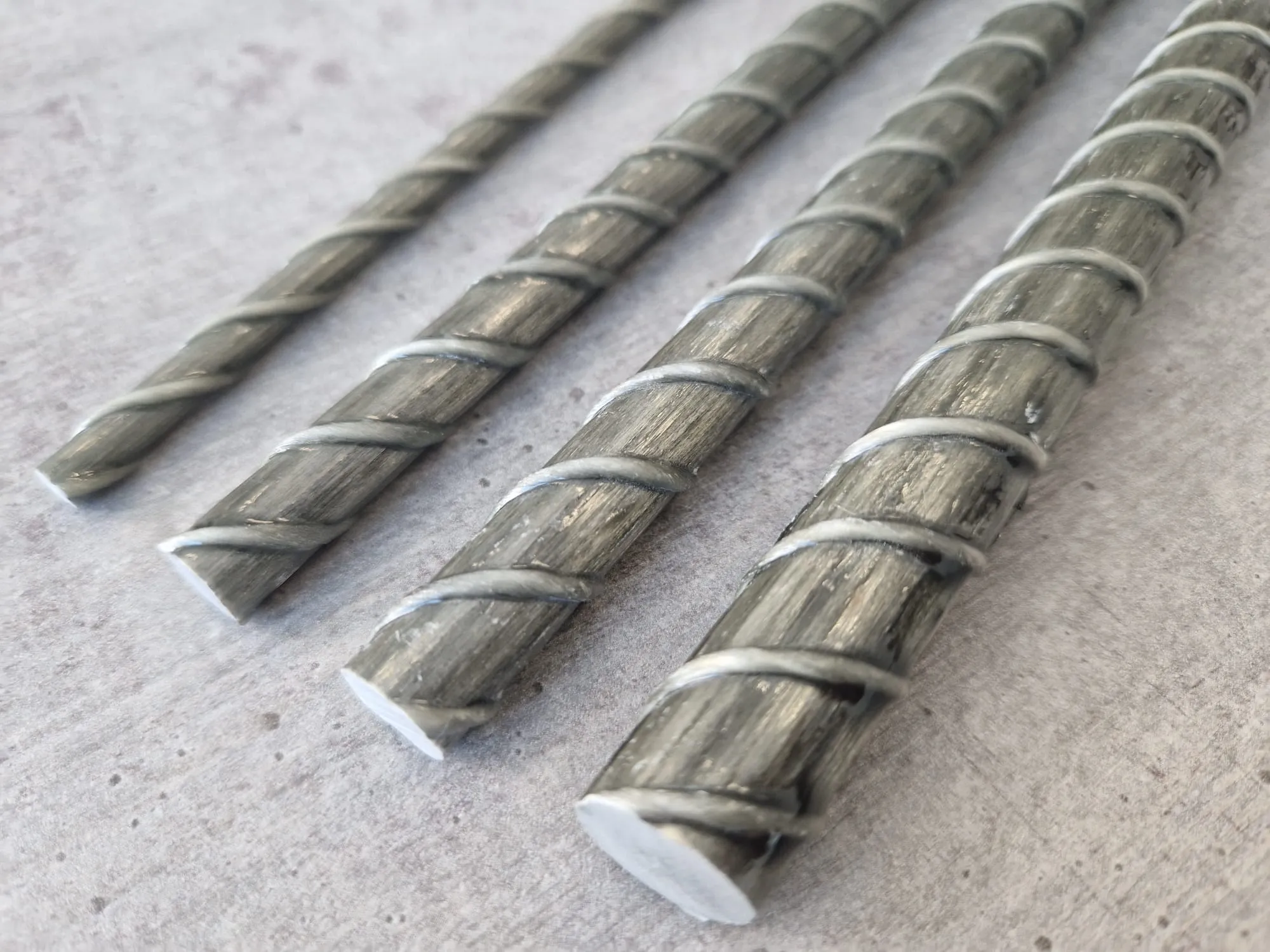
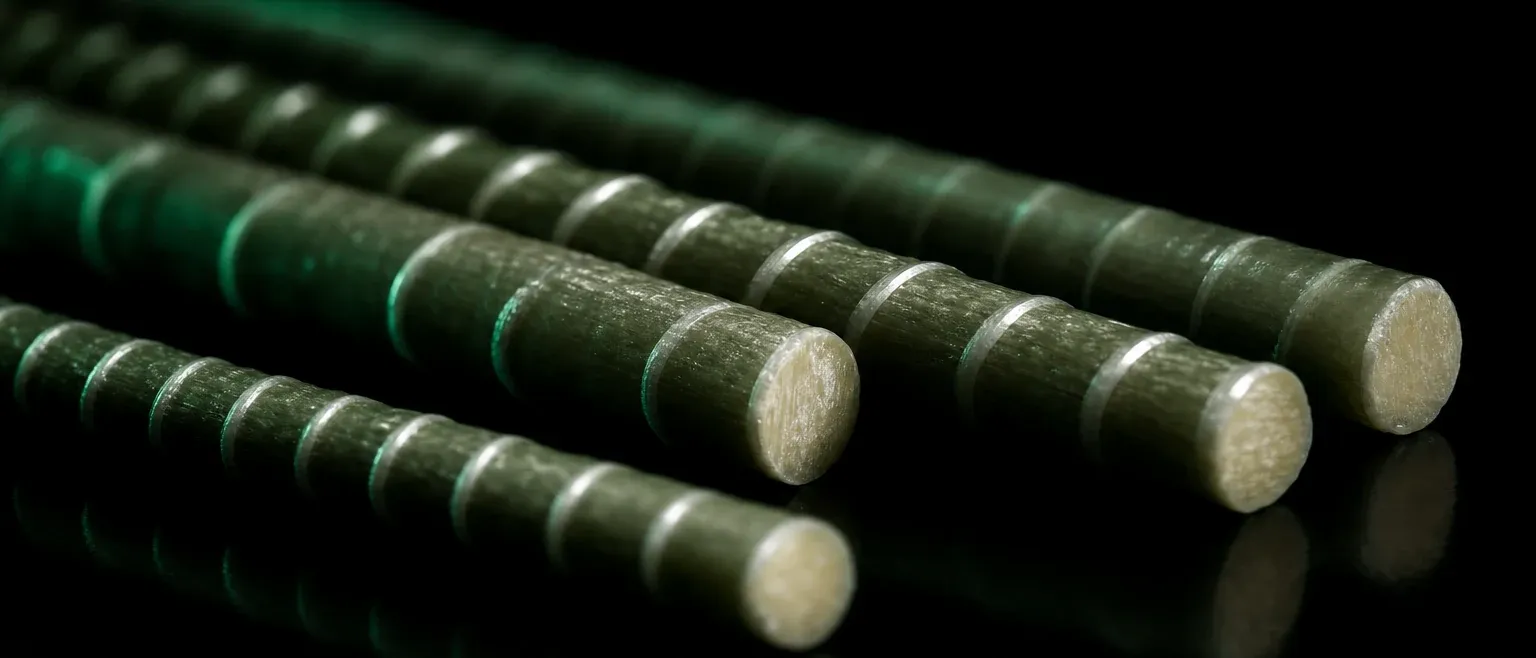
GFRP is glass fibre and a thermoset resin. There is no conductive path through the reinforcement grid. Radio signals propagate through a GFRP-reinforced concrete element with no measurable attenuation contribution from the reinforcement itself.
What the reinforcement
does to the signal.
Indicative penetration loss for six radio bands typically required in modern infrastructure. Steel rebar grids reflect or absorb most of the energy; GFRP contributes only the concrete cover's own loss.
Penetration loss values are indicative for a 200 mm reinforced-concrete slab with standard mesh spacing. Project-specific RF modelling is run with our partners on every tunnel cooperation.
Where signal transparency
is the spec, not a bonus.
Six element families across tunnel, medical, rail and electrical infrastructure where GFRP is not an optimisation — it is the only reinforcement option that meets the brief.
- 01Tunnel linings
Segmental and cast-in-situ. GFRP secondary mat behind the steel primary mat is the most common detail for new builds; full-GFRP for utility tunnels and signalling tunnels.
- 02TBM soft-eyes
Sections of the launch and reception shafts the tunnel-boring machine cuts through. GFRP is cutter-head-safe at Ø 16 mm.
- 03MRI suites & medical
Floor and shielding slabs around magnetic-resonance imaging rooms. GFRP allows the structural cover to coexist with the magnetic field.
- 04Rail interlockings
Concrete bases for signalling, switch heaters and balise installations. GFRP eliminates inductive interference with the track circuit.
- 05Transformer pads
Substation foundations and transformer bases. GFRP removes stray-current loops and earthing complexity.
- 06Embedded-sensor decks
Bridge decks and parapets specified to host fibre-optic, strain and corrosion sensors over a 50+ year monitoring horizon.
A dense tunnel network.
Hundreds of kilometres of concrete.
The Swiss federal road tunnel network is one of the densest in the world. Most of it was built before 5G existed and before structural-health monitoring was specified into the brief. Retrofitting signal infrastructure into a steel-reinforced shell costs an order of magnitude more than building the next generation in GFRP from the start.
The Gotthard road tunnel alone is 16.9 km. For continuity of 5G connectivity, emergency services radio, and the next generation of vehicle-to-infrastructure signalling, the reinforcement logic is now part of the communication brief.
Steel reinforcement reflects radio signals back to where they came from. For 5G, signalling, and embedded sensors, that is the design problem GFRP exists to solve.
For the design office.
Six notes that come up in every tunnel cooperation. None of them invalidate the codes — they direct the engineer toward GFRP-appropriate detailing for radio-transparent and TBM-compatible work.
- Cover
- EN 1992 standard cover retained. No reduction for GFRP — signal transparency comes from material composition, not from cover dimensioning.
- Bond β
- ≈ 1.0 with sand-coated + helical-wrap GFRP per ETA 23/0523 (EAD 260023-00-0301). Same anchorage development as ribbed steel.
- TBM compatibility
- Soft-eyed sections in Ø 16 mm GFRP allow tunnel-boring machines to cut through reinforcement without retooling.
- Hybrid sections
- Steel primary mat + GFRP secondary mat is common in main tunnel linings. Full-GFRP for utility tunnels and signal-critical zones.
- Code references
- fib MC 2020 §17 · ACI 440.11-22 · ISO 10406-1. Project-specific RF modelling on every tunnel cooperation.
- Embedded sensors
- GFRP rebar can be embedded with fibre-optic strain gauges and corrosion sensors. The composite envelope does not attenuate the sensor signal.
What tunnel designers ask first.
- Three reasons. First, GFRP is non-magnetic and non-conductive, so it does not interfere with rail signalling, 5G transmission, GSM-R or MRI suites. Second, the drainage runoff inside tunnels carries chlorides and acids that attack steel-reinforced linings. Third, GFRP is non-leaching and food/water-grade safe inside the concrete envelope — relevant for potable-water tunnels and aquaculture-adjacent infrastructure. Composite Group supplies GFRP for tunnel-lining projects across the EU.
- Yes. GFRP rebar has zero magnetic permeability and zero electrical conductivity. This is what makes it the standard reinforcement for MRI suite floors and walls, magnetic-resonance research facilities, rail signalling interlockings, and radar/transmission tower foundations. A typical clinical MRI installation with steel-reinforced floors needs a 4–5 m clearance band around the magnet — with GFRP-reinforced floors, the clearance band collapses to zero.
- Yes — radio-transparent tunnel construction is one of the fastest-growing GFRP categories in the EU as 5G rollout reaches buried and tunnelled infrastructure. The reinforcement does not attenuate radio frequencies in the 600 MHz to 6 GHz range relevant to 5G, GSM-R or DMR-Tetra rail signalling. Tunnel linings, signalling vaults, and antenna-mast foundations are all standard GFRP specifications under ETA 23/0523 (EAD 260023-00-0301).
- Yes — MRI suite construction is a signature GFRP application. The reinforcement is non-magnetic, non-conductive and produces no eddy-current effects under the 1.5T, 3T or 7T fields used in clinical and research MRI. GFRP reinforcement is specified in floors, walls and ceilings of the magnetic-isolation envelope. Hospital architects route the specification through ACI 440 design tables; the Composite Group engineering desk supplies the material schedule.

