
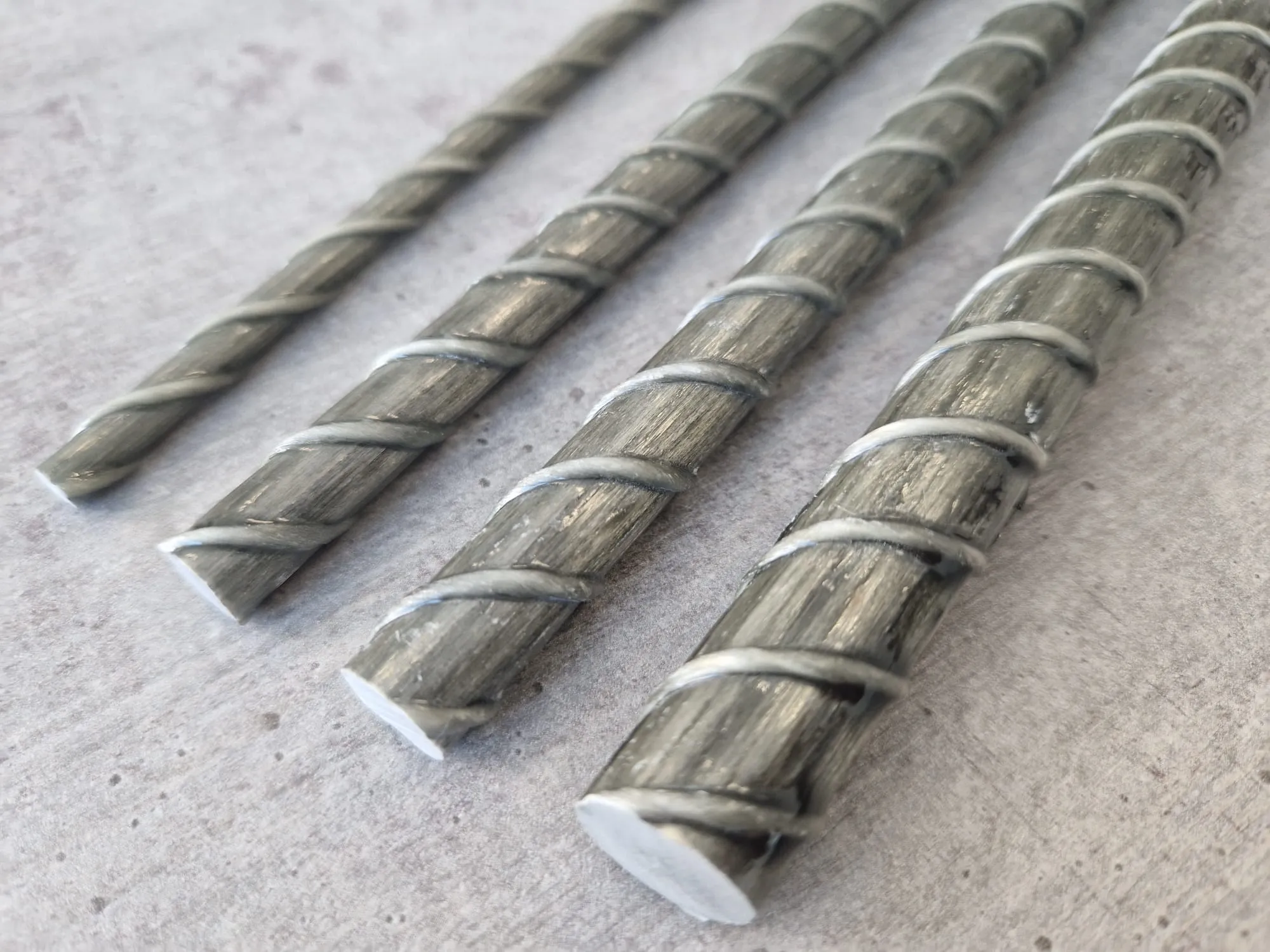
Build once.
Spend less for decades.
GFRP reinforcement removes the single biggest line on a long-term concrete budget — corrosion repair. The commercial case is simpler than it looks: lower transport, no overlap waste, indexed pricing without steel volatility, and a structure that survives its own design life.

The commercial case
is the structural case.
In Swiss road maintenance alone, steel corrosion consumes CHF 260–510 million every year. Bridge decks, retaining walls, parapets, tunnel linings — the dominant cost line is not the structure, it is keeping the steel inside it from rusting.
GFRP removes that line. Specified against the corrosion-protected steel these structures need, it starts at the same cost — and costs less every year for the next eighty. For developers, contractors and investors with long-term budgets, that's the case for GFRP.
Cost flattens
when corrosion stops.
Specified like-for-like against corrosion-protected steel, GFRP starts at the same cost — at or below it on large long-term orders. Then the lines part: steel begins a cycle of corrosion repairs — spalling, deck overlays, partial replacement; GFRP has none. Only one line keeps climbing.
Specified against corrosion-protected steel, GFRP starts level — at or below it on large long-term orders.
Steel begins corrosion-driven repair cycles — spalling, overlays, partial replacement. GFRP is unchanged.
Each steel repair widens the gap; GFRP adds nothing. Over the service life, lifecycle modelling shows 40 – 70 % lower total cost in corrosive exposure (ACI 440).
Illustrative. Project-specific lifecycle modelling is part of step one of every cooperation.
Four sources,
each with a number.
The savings are not one big number. They are four smaller numbers stacking up across the project — and continuing to stack up for decades after handover.
- 01 PRICINGNo steel market volatility
Our GFRP pricing isn't tied to the steel market, and we offer 3 – 5 year price fixing on long-term projects. Budgets hold across the whole development, not just the procurement window.
3 – 5 yrprice fix available - 02 TRANSPORTOne truck does the work of seven
Four times lighter per metre than steel. One articulated trailer of GFRP coils delivers what would otherwise take seven to eight rebar deliveries.
1 : 7–8truck ratio - 03 INSTALLATIONNo overlap waste
Continuous coils have no lap splices. The overlap and offcut you would otherwise scrap at every bar joint is simply not there.
0lap splices - 04 MAINTENANCENo corrosion repair cycle
The single biggest line on a long-term concrete budget — chloride-driven repair, deck overlays, partial replacement — disappears entirely. Counted across 80 years, the saving dominates.
80+ yrflat maintenance line
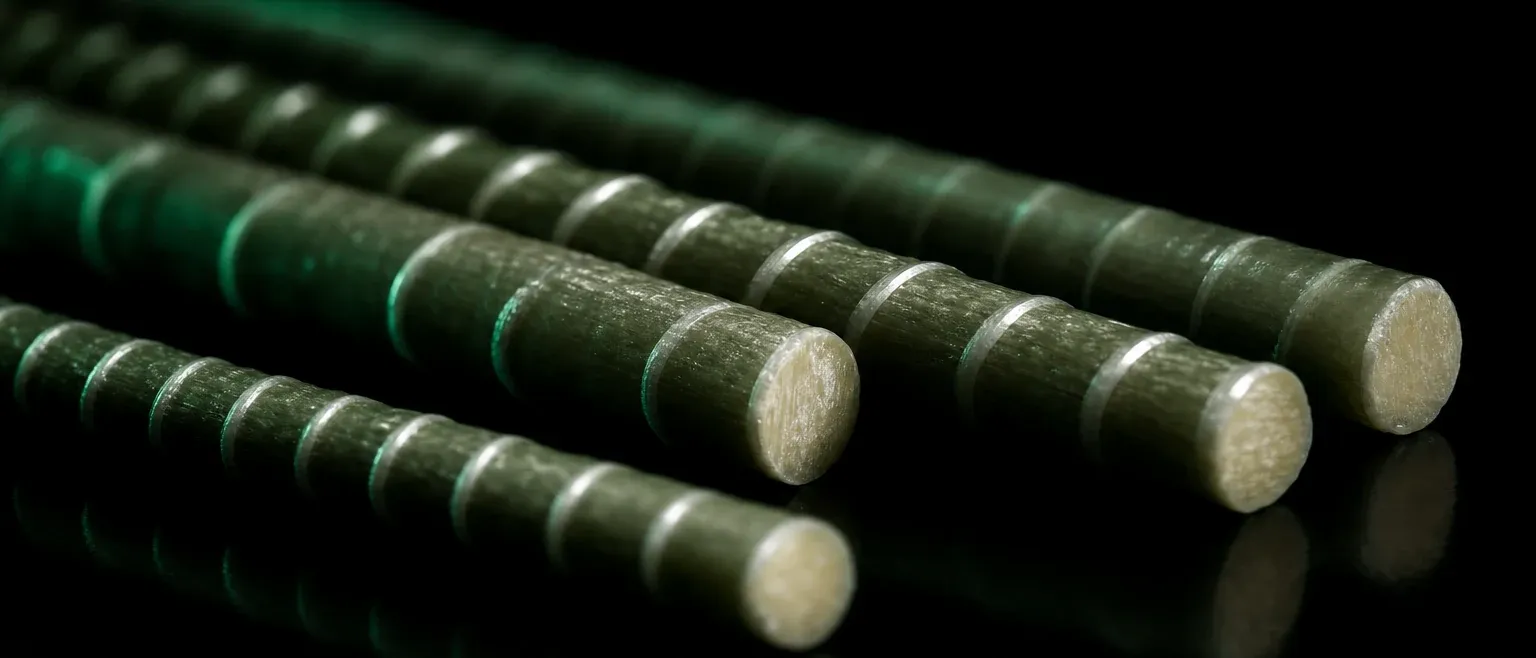
Where the case
has already been made.
Three projects with their commercial outcomes on record. Full case-study documents available on request — including bill-of-materials comparisons and post-pour reviews.
A 21.3 km flood-control channel through a coastal city, exposed to salt water, sand, intense heat. Specified in GFRP after chloride-attack lifecycle modelling against steel.
Slab reinforcement delivered on coils. Half the rebar tonnage, four times the installation speed, eighty-five percent less transport.
Composite Group (via FROOT) was selected from 75+ applicants in the Elemental Impact Build Better Innovation Challenge — funded pilot deployments and technical scaling support.
A full case-study deck (Mibach, Jizan, Galanta production facility) is available on request.
The sustainability advantage of GFRP is not in the production of the bar itself — it is in the decades of avoided maintenance, transport, and material replacement that follow.
Earns credits
in three rating systems.
The EPD (EN 15804 +A2, EuCIA-verified) makes GFRP a contributing material toward the major sustainability rating systems used on European and international developments. Indicative credit categories below — specific point counts are project-dependent.
- LEED v4.1US · internationalContributes to
- MR — Building Product Disclosure (EPD)
- MR — Sourcing of Raw Materials
- IN — Innovation in Design (low-carbon material)
- BREEAMUK · EuropeContributes to
- Mat 01 — Life-cycle impacts
- Mat 03 — Responsible sourcing
- Wst 02 — Recycled aggregates / material reuse
- DGNBGermany · DACHContributes to
- ENV1.1 — Building life-cycle assessment
- ENV1.2 — Local environmental impact
- TEC1.6 — Ease of recovery and recycling
One factory,
one supply chain.
Composite Group manufactures every metre of rebar in a single vertically-integrated facility in Galanta, Slovakia. Fibre to packaged bar, under one roof — which makes lead times short and certificates traceable to the batch.
- Single-batch traceability
Every shipment carries the mill test certificate from the production run the bars came from.
- European supply chain
Raw materials sourced within the EU. No exposure to international shipping cycles or foreign-currency price shocks.
- No third-party sub-supply
Composite Group manufactures the full bar in-house — pultrusion, winding and sand coating under one roof. No second-tier vendor to fail.
- Local engineering support
Our engineering desk supports the design office directly — from specification to detailing.

