
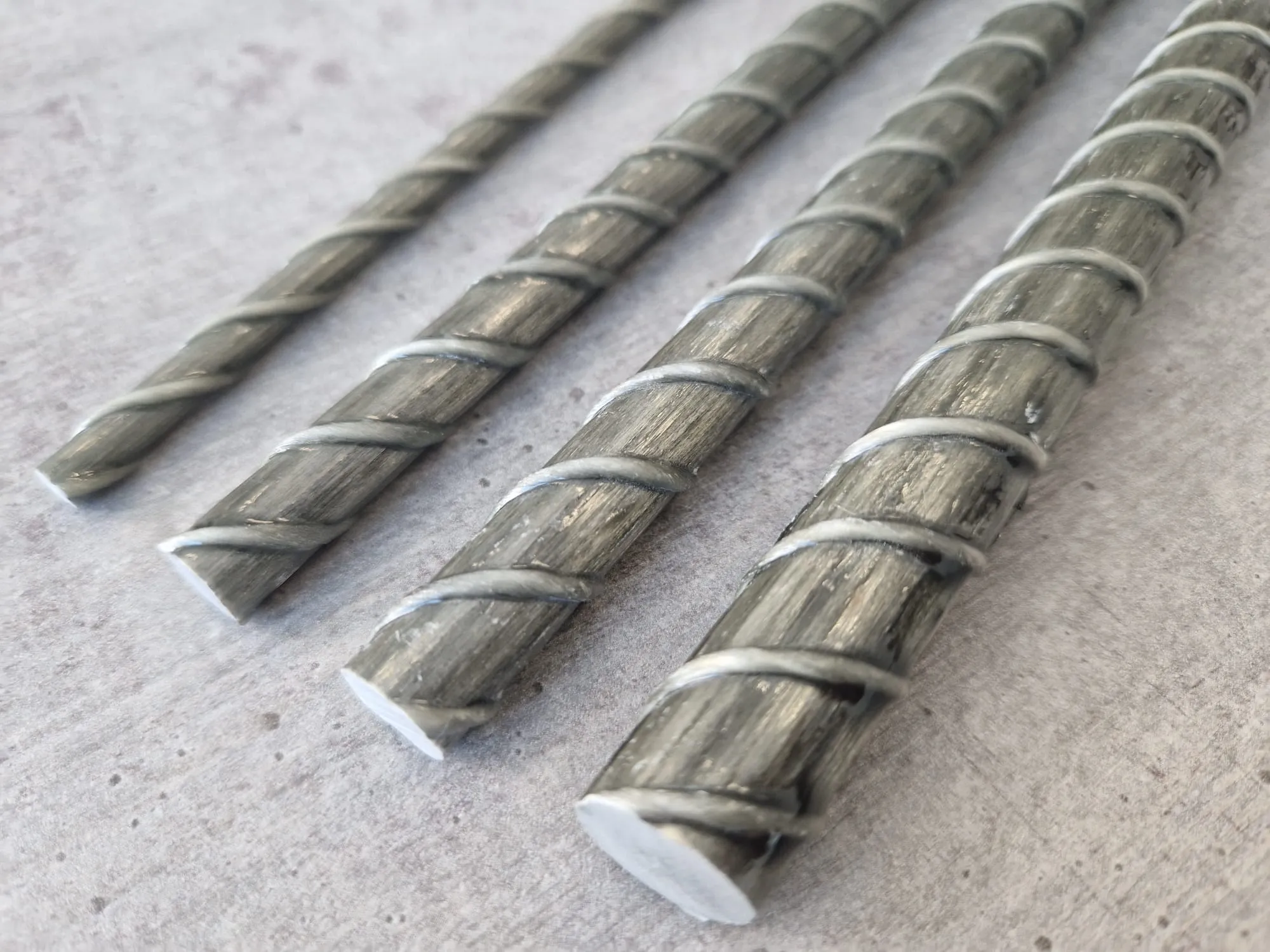
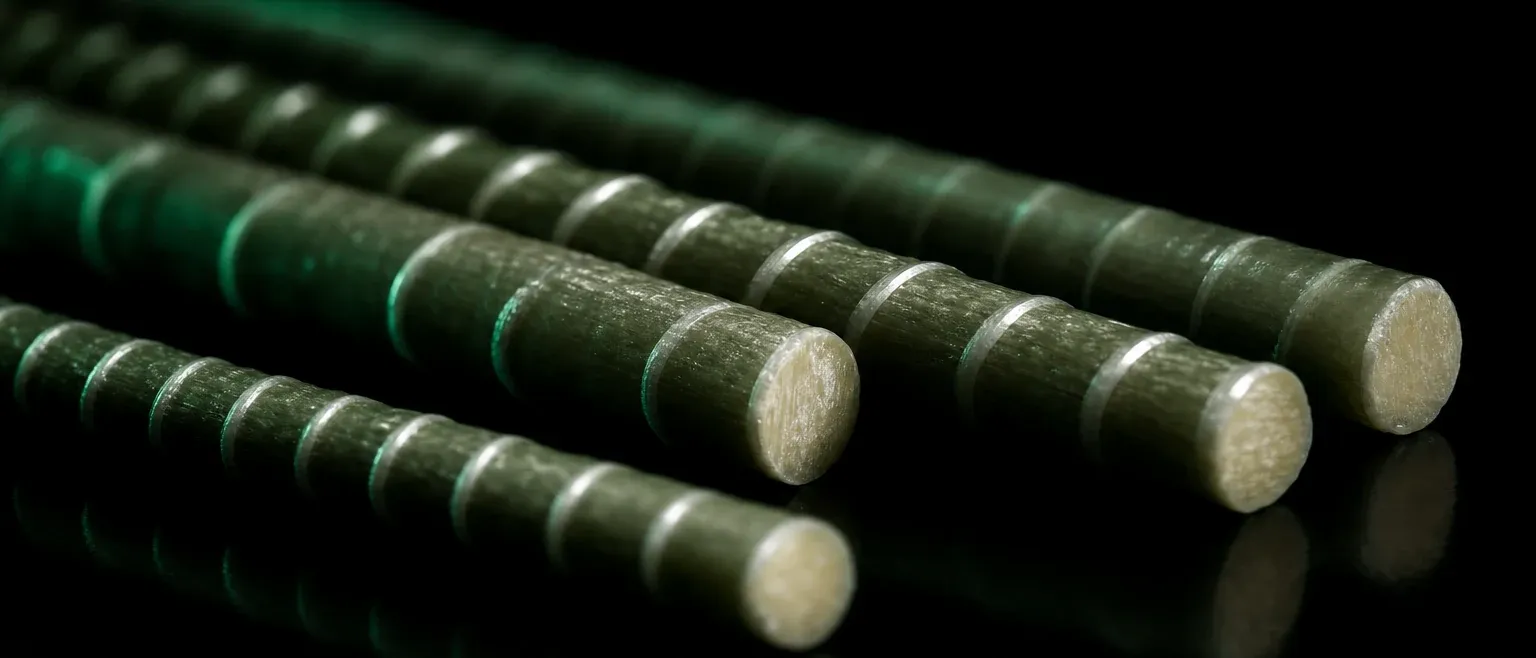
GFRP rebar vs steel.
GFRP replaces steel reinforcement in concrete. The fair comparison isn't against uncoated steel — it's against the corrosion-protected steel these structures need. On that basis: here is where GFRP wins, and where steel still does.
When GFRP wins,
and when steel does.
GFRP is the right choice where corrosion governs the life of the structure — coastal, de-icing salt, chemical exposure, and any element where chloride reaches the bar. It is also specified where the structure must be non-conductive or radio-transparent. Steel keeps the edge where the design depends on ductile yielding, on high-cycle fatigue resistance, or on exposed fire performance. Most of the time one question settles it: does the environment corrode steel before the structure reaches the end of its design life?
The comparison,
property by property.
| Property | GFRP rebar | Steel rebar (corrosion-protected) |
|---|---|---|
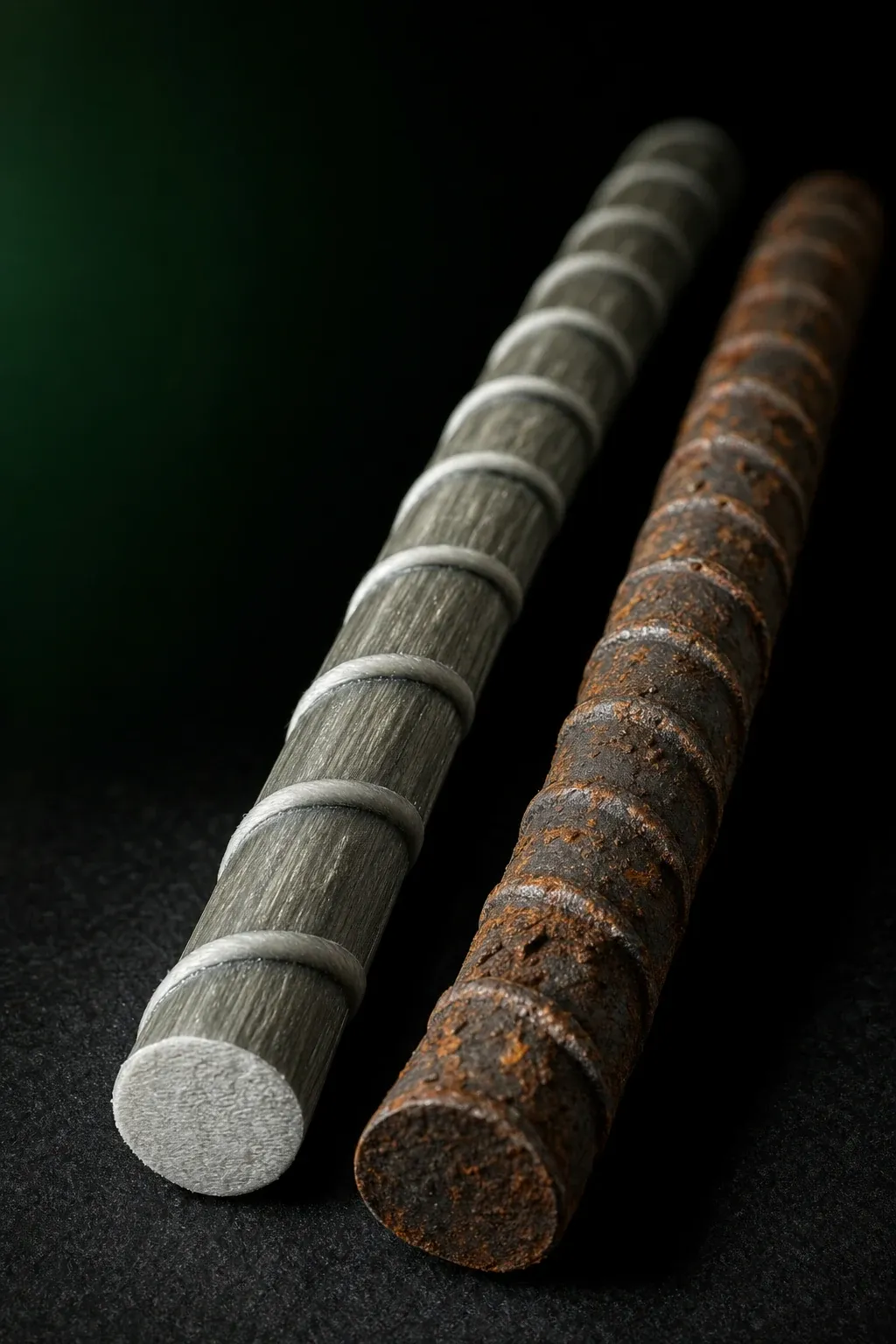
| Corrosion | Does not corrode — chlorides, salts, alkalis, acids | Corrodes; chloride attack governs service life |
| Tensile strength | 940–1,200 MPa (up to 2.4× steel) | ≈ 500 MPa yield (B500B) |
| Weight | ≈ ¼ of steel (≈ 2.0 g/cm³) | ≈ 7.85 g/cm³ |
| Stiffness (E-modulus) | ≈ 52 GPa — lower; deflection often governs | ≈ 205 GPa |
| Stress–strain | Linear-elastic to failure (no yielding) | Yields before failure (ductile) |
| Electromagnetic | Non-conductive · non-magnetic · radio-transparent | Conductive · magnetic |
| Embodied carbon | Up to 70 % lower (EuCIA) | Baseline |
| Service life in concrete | 80+ years | Cover-dependent; often 20–50 yr in chloride exposure |
| Cost basis | Level on a like-for-like spec; lower lifecycle cost | Cheaper per kg as bare bar; higher lifecycle cost |
Tensile values per ETA 23/0523 (characteristic 884–1,104 MPa). Steel reference: B500B.
The deciding
mode of failure.
Steel rebar carries a corrosion budget. In chloride exposure — seawater, de-icing salt — that budget is spent decades before the structure reaches the end of its design life. The rust expands to several times its original volume, cracks the cover and spalls the concrete. GFRP does not corrode. The concrete cover then protects the structure, not the bar — which changes the entire maintenance logic of the asset.
Where GFRP replaces steel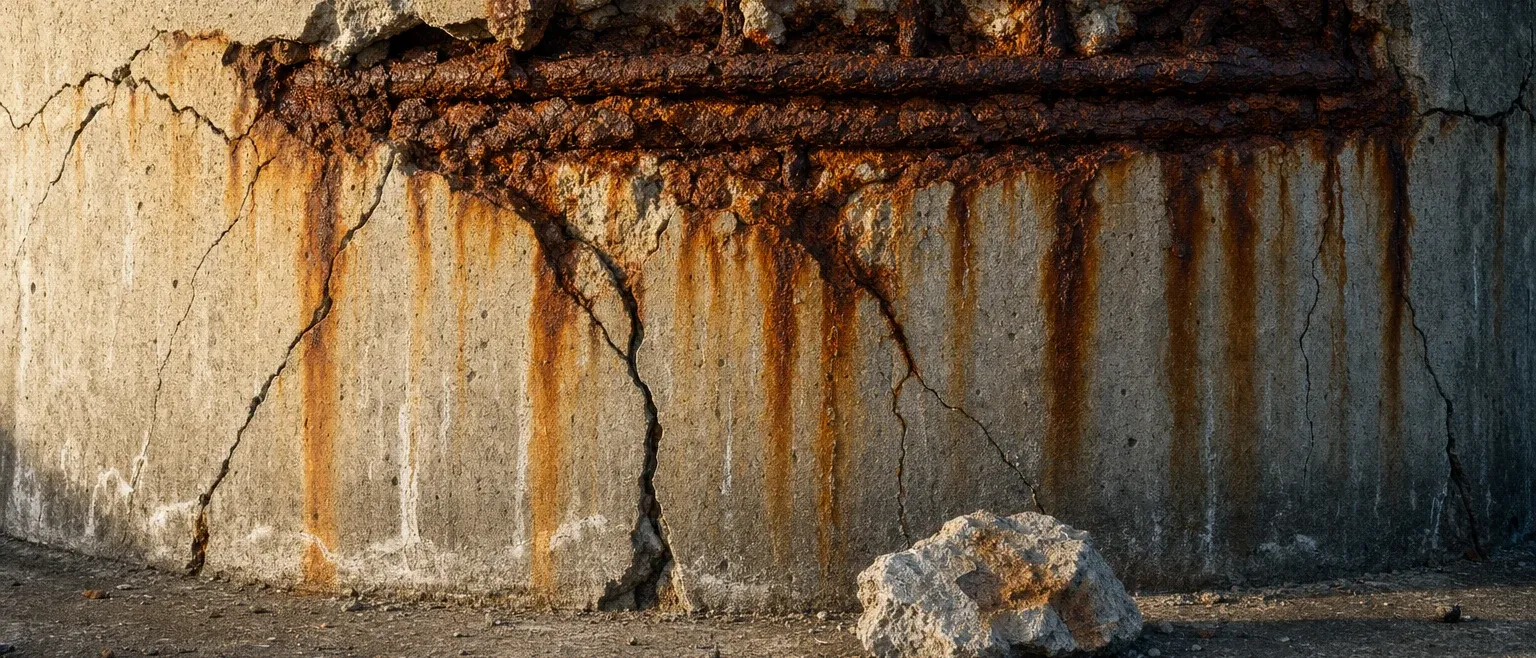
Stronger in tension,
a quarter of the weight.
GFRP reaches 940–1,200 MPa tensile strength — up to 2.4× the yield strength of typical steel rebar — at roughly one quarter of the weight. One truck of GFRP replaces seven of steel rebar: fewer deliveries, lighter handling, less transport carbon. The trade-off an engineer designs for is stiffness. GFRP’s elastic modulus is about 52 GPa against steel’s 205. Deflection and crack-width checks, not strength, usually govern the section.
Technical specificationWe name the limits.
GFRP is not a universal steel replacement, and saying so is part of the cooperation. Three cases stay with steel — or with a hybrid steel-and-GFRP section.
Railway bridges, machine foundations, heavy-cyclic industrial decks. GFRP fatigue performance is lower than steel; these stay with steel or a hybrid section.
GFRP is linear-elastic to failure with no yielding. Structures that rely on ductile yielding to dissipate seismic energy need a hybrid (steel + GFRP) section.
The resin matrix is Tg-limited. GFRP is engineered for encased and buried use — not for load-bearing members exposed to fire.
Read it over the
life of the structure.
On a like-for-like specification basis — against the corrosion-protected steel these structures need — GFRP is level on first cost. It then removes decades of repair, recoating and traffic closures. Per kilogram, bare steel is cheaper. Over the life of a chloride-exposed structure, it is not.